Table of contents
- How Does a Dash Cam Work?
- State-Specific Dash Cam Laws
- Can You Use Dash Cam Footage as Evidence in a Car Accident Case?
- Legal Standards and Challenges With Dash Cam Evidence
- When is Dash Cam Footage Considered Useful?
- When is Dash Cam Footage the Least Helpful?
- How Do I Know If My Dash Cam Footage Is Admissible in My Car Accident Injury Case?
More drivers are using dash cams every day, and for good reason. They capture what really happened when a crash unfolds in front of you.
And yes, your own dash cam footage can be used in a car accident case, as long as it’s clear, authentic, and legally recorded. That’s why people want to know: Is my dash cam legal? Will the video actually help my claim? The short answer is that dash cams are legal in every state, but how and where you use them can decide whether the footage becomes powerful evidence or something the insurance company throws out.
How Does a Dash Cam Work?
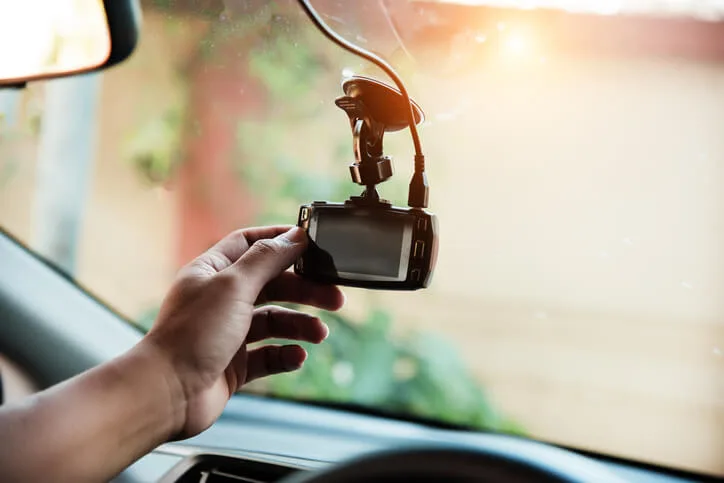
A “dash cam,” short for “dashboard-mounted video camera,” is just what it sounds like. Dash cams are a device that can be attached to a spot on your vehicle to record video footage, often mixed with audio. Most dash cams are forward-facing, looking out the front windshield, and they may also be attached to look out the rear window when permitted by state law.
Dash cams record whenever they are on. A dash cam can be manually activated each time the driver wants to use it or automatically “wake up” when the vehicle is on. Sometimes they can be triggered to start even when the car is parked, potentially catching a hit-and-run in the act while you get groceries or attend a sports game.
Because dash cams have a limited storage capacity, usually enough for around 6 hours of footage, they will overwrite older footage unless it is manually saved and stored by the owner.
That’s all there is to it! Like most cameras, you “point and shoot,” except you don’t even have to point since the camera always faces forward.
Anyone who wants to use a dash cam should be aware of relevant state laws, though. They should also test the footage to see if the camera’s view is unobstructed and if the video quality is enough to be clear and decipherable.
State-Specific Dash Cam Laws
Dash cams are more common than ever, and they can make or break a car accident claim. They’re legal in every state, but each state sets its own rules on where you can mount the device, what you can record, and how audio is handled. Missouri and North Carolina have no restrictions when it comes to dash cams.
Other states allow dash cams as long as they don’t qualify as a windshield obstruction. If your dash cam is recording audio, though, you need to make sure what the wiretapping laws are in your state. Some states require the consent of everyone being recorded, while other states do not require consent. Recording police and other public servants in the course of their duties may be an exception to this wiretap law.
Here’s how the laws work in our core states:
Florida
Dash cams are allowed as long as they don’t create a dangerous windshield obstruction. Florida is a one-party consent state for audio, so you can record conversations you’re part of. Footage recorded with an illegally mounted camera can be challenged in court.
Tennessee
Dash cams are legal if they don’t block the driver’s view and comply with equipment rules. Tennessee is also a one-party consent for audio. Because Tennessee uses modified comparative fault, any footage showing partial blame can reduce your recovery.
Texas
Texas allows dash cams that don’t interfere with the driver’s clear view. Texas is one-party consent as well for audio. Courts often look closely at whether the footage was legally obtained and kept in its original, unedited format.
Can You Use Dash Cam Footage as Evidence in a Car Accident Case?
Since dash cams are legal in all 50 states, they just have different rules about audio and visual obstruction; they can be used as evidence in a car accident case. The rules about placing fault for an accident vary in all states. In some car accidents, the fault is very clear. However, in cases when it’s unclear, dash cam footage can help establish who was at fault. Dash cam footage being used as evidence can be a double-edged sword as well. Dash cam footage, depending on how long it was recorded before the accident occurred, could show that you may have caused the accident.
It is also important to note that in order for dash cam footage needs to be treated like any photo or video evidence, not altered. The dash cam footage needs to be in its original form, no edits, so it can be deemed reliable when used in a case.
Legal Standards and Challenges With Dash Cam Evidence
Courts don’t accept dash-cam footage just because you have it. Before it helps your case, the video has to be relevant, authentic, and clear enough to stand on its own. That means no edits, no gaps, and no confusion over who handled the file after the crash. Judges can require the person who recorded the video to testify that it’s real, and privacy rules, especially when audio is recorded, can complicate things.
There are also a few technical and legal requirements that make footage stronger in court:
- Keep the raw file with original metadata (time stamps, GPS, creation date).
- Back it up securely without trimming or editing, and altered footage can be thrown out.
- Use a legally mounted camera that doesn’t block the windshield.
- Check your state’s audio consent laws if the device records sound.
Quality matters, too. Blurry footage, bad lighting, or a narrow field of view can undermine your entire claim. Cameras with 1080p resolution, wide-angle lenses, night vision, and impact-triggered save features tend to hold up better when insurers challenge the footage.
When privacy is a concern, redaction tools such as Redactor can blur faces or plates, but only on a copy. The original must stay untouched for the court.
When is Dash Cam Footage Considered Useful?
Dash cam footage can show driver behaviors that affirm a narrative that a driver was at-fault and acting negligently. For instance, if an injury victim alleges that a car was recklessly driving before it merged into their lane and collided with them, footage of the car swerving moments before the accident can be beneficial.
Likewise, if a hit-and-run driver claims to be misidentified, footage clearly shows their vehicle and license plate number immediately after a front-end collision. The dash cam video can potentially provide strong evidence of fault.
When is Dash Cam Footage the Least Helpful?
On the other hand, there are situations where dash cam footage might not support your car accident claim. If the camera didn’t capture an obvious action or the full scope of the accident scene, it might not clearly and convincingly prove the facts that the injury victim hoped it would. Similarly, if the footage is grainy or couldn’t adequately capture the scene at night, then it may not be helpful to the case.
One situation where dash cam footage can do more harm than good is if it proves that an injured victim somehow contributed to their accident. If the video shows that they hit the other driver first, contrary to their claim’s narrative, the victim doesn’t want to volunteer that footage (nor should they attempt to make false claims, but that’s another matter).
Even footage of events leading up to an accident can be fair game, so consider the full scope of what the footage shows. If moments before the accident you were speeding and nearly missing cars, this can prove that you were driving recklessly and contributing to the circumstances of the accident, even if the video doesn’t disprove anything material in the claim.
And here’s the part most drivers don’t realize: dash-cam footage is a double-edged sword. If it shows you speeding, distracted, or contributing to the crash in any way, the insurance company will weaponize it. We see it every day. Before you hand over a single frame, let us review it so you don’t end up giving the insurer ammunition they shouldn’t have.
How Do I Know If My Dash Cam Footage Is Admissible in My Car Accident Injury Case?
Many factors can affect whether dash cam footage should be used in a car accident injury claim and how much value it can provide the victim. In that case, it’s generally best to discuss the details with an experienced car accident lawyer immediately.
At Steinger, Greene & Feiner, we’ve helped thousands of clients across Florida, Tennessee, and Texas use dash cam footage to prove what really happened on the road. From West Palm Beach, Miami, Fort Lauderdale, Tampa, Port St. Lucie, Nashville, Dallas, and beyond, our team knows how to secure the footage, preserve it the right way, and present it so insurance companies and juries take it seriously. You can schedule a free, no-obligation case review with a car accident attorney today.